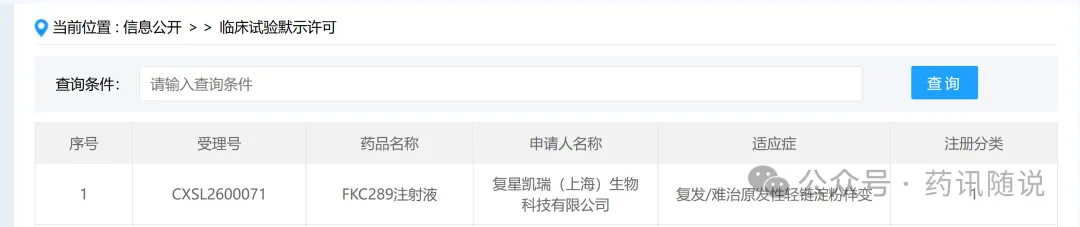
According to public information from the Center for Drug Evaluation (CDE) of China's National Medical Products Administration (NMPA), FKC289 Injection, developed by Fosun Kairos (Shanghai) Biotechnology Co., Ltd., has been granted implicit approval for a clinical trial in relapsed/refractory primary light chain amyloidosis.
A Dual-Target CAR-T Aimed at Plasma Cell Disorders
FKC289 is a dual-target autologous CAR-T cell therapy directed against both BCMA and CD19. By targeting the BCMA and CD19 surface antigens, it achieves deep depletion of pathogenic plasma cells and/or B cells — enabling treatment of plasma cell disorders and/or B-cell-mediated autoimmune diseases.
About Primary Light Chain Amyloidosis
Primary light chain amyloidosis (ALA) is a rare disease associated with abnormal clonal plasma cell proliferation. In ALA, monoclonal immunoglobulin light chains misfold into amyloid proteins that deposit in tissues and organs such as the heart and kidneys, ultimately leading to progressive failure of multiple organs.
The prognosis of ALA is highly heterogeneous. Patients with severe cardiac involvement have a median survival of less than one year, and treatment options for relapsed/refractory (R/R) patients remain scarce — a significant unmet medical need that new therapies like FKC289 aim to address.
Global Context: CAR-T Enters Rare Disease Territory
The approval reflects a broader global trend of CAR-T cell therapies expanding into rare plasma-cell and autoimmune diseases:
Related developments worldwide
- In February 2025, NXC-201 — a BCMA-targeted, spatially optimized CAR-T developed by Immix Biopharm for relapsed/refractory light chain (AL) amyloidosis — received Regenerative Medicine Advanced Therapy (RMAT) designation from the U.S. FDA, reporting a 100% response rate in clinical studies
- Talvey (talquetamab), Johnson & Johnson's GPRC5D-targeted bispecific antibody, has been approved in China by the NMPA for the primary light chain amyloidosis indication — an exceptionally fast regulatory review completed in just 55 days
Together with these milestones, the FKC289 clinical trial clearance underscores China's growing role in cell therapy innovation — not only in oncology indications, but also in rare diseases and autoimmune conditions where conventional treatments fall short.
Part of the Fosun Health Global Network
Fosun Kairos and Foshan Chancheng Hospital belong to the same Fosun healthcare ecosystem. As the group's cell therapy pipeline advances into new rare-disease frontiers, Foshan Chancheng Hospital continues to serve as the ecosystem's international care gateway in southern China — through its 20,000 m² Foshan International Medical Center (FIMC), global referral channels and end-to-end services for patients from more than 100 countries.
Together, these moves reflect one direction: connecting patients worldwide with China's medical excellence — and connecting China's medical innovation with the world.