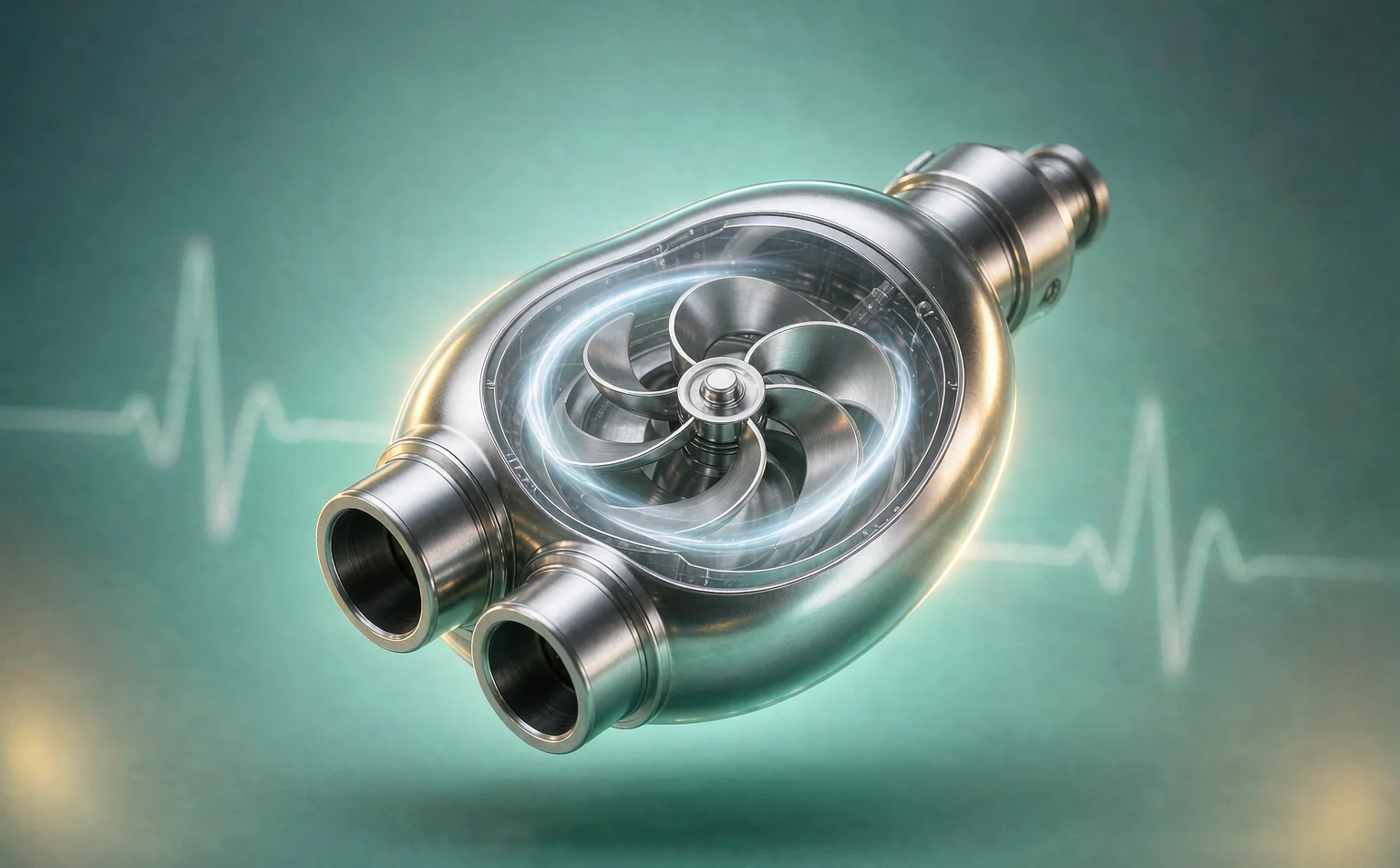
China has an estimated 1.3 million patients with end-stage heart failure. Their hearts are too weak to pump blood effectively — walking leaves them breathless, they cannot lie flat to sleep, and their remaining time is measured in months. The only radical cure is a heart transplant, yet the whole country performs only about 700 heart transplants each year.
For everyone else, the answer for the past two decades has been an expensive one: implant an artificial heart — a miniature blood pump placed inside the chest that takes over the work of the failing heart. And for most of those twenty years, that technology was held by a single American company. Abbott's HeartMate 3 sold in China for about ¥1.5 million — pump alone, surgery not included.
Key Numbers
- About 1.3 million end-stage heart failure patients in China; only around 700 heart transplants performed per year
- Imported HeartMate 3: about ¥1.5 million for the pump alone; total treatment costs once approached ¥2 million
- Domestic CH-VAD price: ¥459,600 (2022) → ¥362,300 (first half of 2025); total domestic treatment now ¥800,000–1,000,000
- CH-VAD: 670+ cumulative clinical implants; Corheart 6 is among the world's smallest full-maglev devices
- 2024: a dedicated national pricing item for ventricular assist device implantation was added, opening the door to medical-insurance linkage
How the Price of a Heart Came Down
The artificial heart is among the hardest devices in medicine to build: a magnetically suspended blood pump implanted in the chest, spinning thousands of times per minute, required to run continuously for years without stopping — and without damaging the blood it pumps. Only a handful of companies in the world have ever achieved it.
For years, the market in China was simple: the only mature product available was imported, and a sole supplier could set a sole price — ¥1.5 million per pump.
The turning point came when domestic manufacturers entered. Today, the approved implantable artificial hearts in China come from five domestic companies — among them Tongxin Medical (CH-VAD), Corheart Medical (Corheart 6) and EVAHEART (Yongrenxin) — and the price has moved just as fast.
CH-VAD, the fastest-moving of the group, fell from ¥459,600 in 2022 to ¥362,300 in the first half of 2025 — a drop of more than 20%, and roughly a quarter of the imported price. Counting the full treatment bill (pump, surgery and hospitalization), imported devices once pushed total costs toward ¥2 million; domestic systems have brought that down to the ¥800,000–1,000,000 range.
Policy has accelerated the shift. In 2024, China's National Healthcare Security Administration convened the manufacturers directly, and one domestic device was subsequently quoted at ¥499,000 — about ¥200,000 below the prevailing price. The same year, the NHSA added a dedicated national pricing item, the "ventricular assist device implantation fee", giving hospitals a standard charge code and opening the door to medical-insurance linkage.
The price of a heart is sliding from "a down payment on an apartment" toward "a premium car."
Why China Dared to Enter the Field
What makes an artificial heart so hard is that it is a living machine. Impeller blades spin thousands of times a minute inside blood; if a mechanical bearing heats up, it destroys blood cells. Magnetic levitation — letting the rotor spin without touching anything — is the technology Abbott spent decades refining.
Chinese manufacturers took a direct route: go straight to third-generation, fully magnetically levitated designs, skipping the bearing-pump "entry-level" stage. CH-VAD and its upgraded version CH-VAD Plus are both full-maglev devices, and CH-VAD has accumulated more than 670 clinical implants — for an implanted device, a credential earned one patient at a time.
Others compete on size and on markets. Corheart 6 is one of the world's smallest fully magnetically levitated artificial hearts — smaller devices mean smaller incisions and faster recovery, and for Asian chest dimensions small is not a luxury but a necessity. Chinese devices are now heading abroad as well: Corheart 6 launched commercialization in Europe in mid-September, while Tongxin Medical's next-generation BrioVAD has received FDA approval to enter clinical trials in the United States — the first Chinese active implantable device to open that door.
A track monopolized for twenty years has, within five, become five Chinese companies competing against one American incumbent.
What Patients Should Know
The trend is real, but so are the caveats. ¥360,000 remains a major expense for most families, and full treatment still costs ¥800,000–1,000,000. Surgical volume is ramping up from a base of 670+ cases: compared with several thousand implants a year in the United States, China's volume is still climbing, and the specialized centers able to perform the procedure nationwide number only in the dozens. BrioVAD's FDA clearance covers clinical trials, not yet market approval — the full trial cycle still lies ahead. And with five domestic players on one track, industry consolidation is likely — which is, in the end, how markets mature.
A Bridge to Transplant — or a New Life
Back to the opening arithmetic: 1.3 million end-stage heart failure patients, 700 transplants a year. Between them stretches a long waiting list — many patients do not lose their lives because medicine has run out of options, but because they cannot wait long enough.
In this sense the artificial heart is not a luxury; it is what the waiting list cannot provide. Medically this is called "bridge to transplant": the pump keeps blood flowing while the patient waits for a donor heart — and for suitable patients it can also serve as long-term "destination therapy", supporting circulation for life.
Every yuan cut from the price puts this therapy within reach of another group of families.
Artificial Hearts and Cardiac Care Across Our Network
Artificial-heart innovation is advancing across Foshan Chancheng Hospital's partner network as well: the HeartCon II ("Rocket Heart 2.0"), a fully magnetically levitated LVAD weighing only 75 grams, has been implanted in beating-heart procedures at our partner hospitals, and that LVAD program recently marked its tenth implantation. Foshan Chancheng Hospital's own Heart Hospital performs TAVR and MitraClip structural heart interventions, and through the Fosun healthcare ecosystem's cardiac network, patients can reach the right technology — from transcatheter valves to ventricular assist devices — at the right center, at the right time.
From a ¥1.5-million imported monopoly to a ¥360,000 homegrown choice, China's artificial-heart story is ultimately about what end-stage heart failure patients need most: more options, and more time.