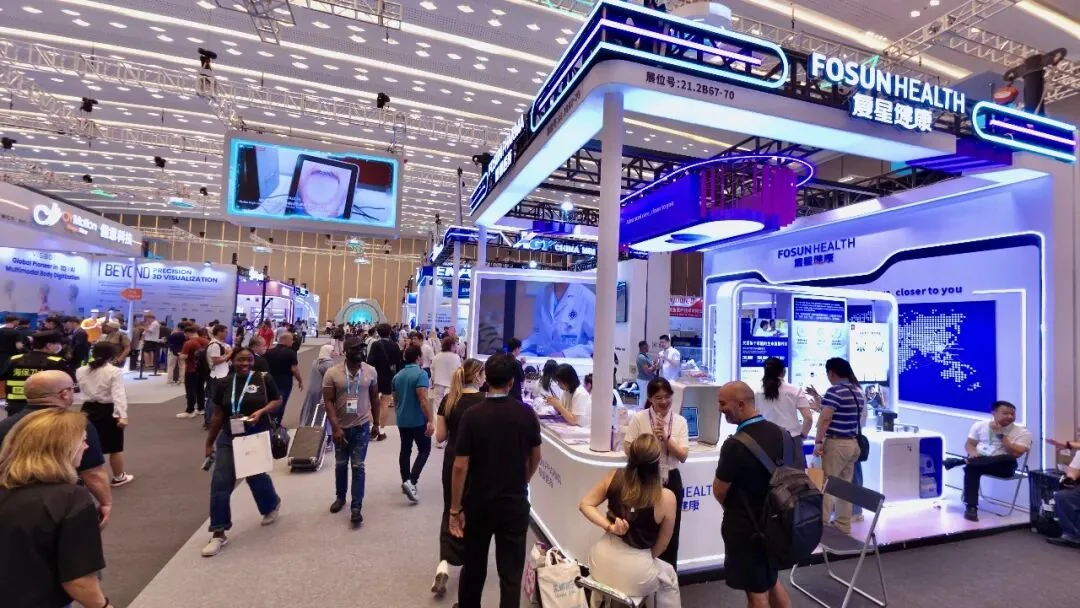
On October 31, 2026, the third phase of the 140th China Import and Export Fair opened its Smart Healthcare Exhibition Area in Guangzhou. Fosun Health came with the international medical centers of its Greater Bay Area hospital group — among them Foshan Chancheng Hospital, Shenzhen Hengsheng Hospital and Zhuhai Chancheng Hospital — together with its overseas network, its AI-assisted care pathway and a hardware line the group calls the robotics team. The theme was simple: technology empowering international healthcare.
Most exhibitors at a trade fair show equipment. The more useful question, for anyone who would actually have to lie on the table, is what the equipment has already done for a patient who arrived from another country. The booth answered in three cases.
A Robotics Team, and Three Patients Behind It
The centre of the stand was occupied by the da Vinci surgical system, an orthopaedic surgical robot and a sixth-generation CyberKnife — three platforms covering precision surgery, bone and joint procedures and precision radiotherapy respectively. The matrix behind them is the group's oncology, orthopaedics and cardiovascular capability, accumulated across its Greater Bay Area hospitals.
The first case was a former professional footballer from Bangladesh whose old knee injury had left the joint severely deformed. He received a robot-assisted knee replacement planned to millimetre tolerance and was standing and walking six hours after surgery.
The second was a Vietnamese patient who came to China after a routine check-up turned up a shadow on the lung. The lesion was removed with a minimally invasive lobectomy on the da Vinci system; he was out of bed the following day.
The third was a Brazilian patient of Chinese descent with residual nasopharyngeal carcinoma after chemoradiotherapy. Treatment combined sixth-generation CyberKnife radiotherapy with immunotherapy; after five sessions the reported symptom relief reached 85 per cent.
Three countries, three platforms, one pattern: the technology is what makes the procedure possible, but the journey is what makes it reachable. Alongside the clinical side of the booth sat the unglamorous machinery of arrival — multilingual coordination, visa assistance, and meals adjusted to the religious and dietary conventions of the patient in the bed.
When Surgery Is Not the Answer
Robots and radiotherapy solve problems of location: seeing the target, reaching it, sparing what surrounds it. They do not solve a tumour that has already spread and stopped responding.
CAR-T cell therapy addresses that from the immune system instead. A patient from Mongolia with advanced gastric cancer had been through repeated rounds of radiotherapy, chemotherapy and targeted therapy abroad over two years, and the disease kept progressing. After CAR-T cell therapy his general condition improved markedly and the disease came under control.
Foshan Chancheng Hospital and its sister hospitals have now treated a series of gastric cancer patients this way, which marks the entry into standardised clinical use of the world's first approved CAR-T therapy for a solid tumour.
The Half of the Booth That Follows You Home
The interactive area drew a steadier crowd than the robots. Smartwatches and fitness bands, Breas respiratory masks, a digital pulse diagnosis device, smart blood pressure and glucose monitors, and an intelligent breast screening unit were set out not as gadgets but as a sequence: screening before treatment, monitoring during it, management after discharge.
That is the part of the offering a patient actually keeps. A surgical robot belongs to a hospital; a blood pressure monitor and a follow-up plan belong to the person who flew home with them.
Where AI Sits in the Pathway
The second half of the exhibition was software, and it was organised around the patient journey rather than around a product.
Before consultation, the Xing Yi mini-program handles intelligent triage, pre-consultation questionnaires, report interpretation and translation, medication queries and health-check guidance; triage output connects to appointment booking, and the questionnaire becomes a structured summary the doctor reads before the patient walks in.
During treatment, a HIS-integrated AI assistant supports evidence retrieval, case summarisation and draft documentation, while a nursing agent assists with admission assessment, shift handover, nursing records and discharge education.
After discharge, AI telephone follow-up and the Xing Lifang platform carry screening, health assessment, nutritional analysis, patient education and care plans past the hospital gate.
For international patients specifically, a dedicated platform parses records in multiple languages, stratifies the case, drafts a preliminary plan and matches it to a hospital — after which clinicians and the international team review it, and the visa invitation letter, insurance direct billing, multilingual accompaniment and remote follow-up are arranged around it.
What the Numbers Say, and What They Do Not
As of October 2026, the group reports that Xing Yi has handled close to 270,000 service interactions, with response efficiency up by more than 60 per cent; that the HIS AI assistant is used by more than 90 per cent of clinicians; that AI-assisted admission assessment has gone from roughly 8 minutes to 3, and shift handover from roughly 10 minutes to 5.
The figures that matter most to a patient sitting in another country are these: preparation of a preliminary treatment plan has fallen from 2 to 5 days down to 1 to 2 hours, and a single coordinator can now handle 15 to 30 cases a day instead of 3 to 5 — roughly five to six times the previous intake capacity.
At Foshan Chancheng Hospital, AI follow-up has placed more than 83,000 outbound calls over the year, with a 72 per cent connection rate and a 55 per cent task completion rate — which is the point of automating the routine half of follow-up: it frees staff for the patients who need a person.
The group is explicit about the boundary. AI handles information sorting and standardisation. Diagnosis and treatment decisions, content review and communication with patients remain with clinicians and the international team. That distinction is worth stating plainly, because a patient reading about artificial intelligence in medicine is entitled to know which side of the line the decisions fall on.
Why a Trade Fair Matters to a Patient
Hu Hang, Chairman and Chief Executive Officer of Fosun Health, put the strategy in one line: the essence of international healthcare is connecting quality medical resources worldwide. With the group's network reaching across Southeast Asia, Central Asia and beyond, the cross-border capability of its Greater Bay Area hospitals is deepening — and with policy support behind the sector, smart healthcare becomes the means of making that capability more accessible rather than the end in itself.
For a patient, the practical test is unchanged: can a person get from an enquiry to a consulting room without friction. Foshan Chancheng Hospital has run an international medical service since 2019, now reaching patients from more than 140 countries and regions across 30,000-plus visits; its International Medical Center, fully open since March 2026, holds outpatient, inpatient, screening and rehabilitation across 20,000 square metres and pairs each patient with both a general practitioner and a specialist.
An exhibition booth cannot demonstrate that. But it can show the two halves that have to meet for it to work — the machine that makes a difficult operation ordinary, and the process that makes the operation reachable from 4,000 kilometres away. Earlier this month we wrote about the fair's first healthcare zone and the media attention it drew; that report is here.
Arriving in Guangzhou or Foshan for the Canton Fair and want a second opinion, a screening or a specialist consultation while you are here? Our multilingual team can build it around your exhibition schedule, including visa invitation letters and remote follow-up after you fly home.